

The AI Operating Stack for Consumer Brands, Part 4: Hire, Tool, or Agent?
What the $100M brand with 30 employees actually looks like

This is the final part of a four-part series on building the AI operating stack for consumer brands. Parts 1 through 3 covered building your foundation, diagnosing what’s broken, and making AI work inside a running operation (LINKS). Part 4 is the finale — the org chart question that determines whether everything compounds or collapses.


We Started With a Claim. Let’s Close It.
In Part 1, we made a specific assertion: the next generation of $100M consumer brands will operate with fewer than 30 employees. We’ve already seen it happen. These brands aren’t cutting corners, but are building smarter from the start.
That claim raises an obvious question that we’ve been building toward for three parts: what does that team actually look like, and how do you decide what’s a human, what’s a tool, and what’s an agent?
To put it in context: Church & Dwight — famously one of the leanest operators in CPG — generates approximately $1.3M in revenue per employee. They’re proud of it. They call it out in their annual report as one of the lowest overhead rates in the industry. It’s a genuine competitive advantage that shows up in margin, in agility, and in their ability to reinvest in brands rather than headcount.
That’s the legacy benchmark. The AI-native CPG brand we’re describing runs at $3M–$5M in revenue per employee — two to three times Church & Dwight, at a fraction of the scale. Not because they work harder, but because they designed the operating model differently from day one.
Most founders approach this question backwards. They hire first — because hiring feels like progress — and then try to figure out what tools to add around the team they’ve built. The result is a $5M brand with a $3M payroll and a $2M revenue problem.
The right sequence is the inverse: design the operating model first, then hire into the gaps that tools and agents genuinely cannot fill.
The Decision Framework: Hire vs. Tool vs. Agent
Before looking at specific roles, here’s the filter we apply to every function:
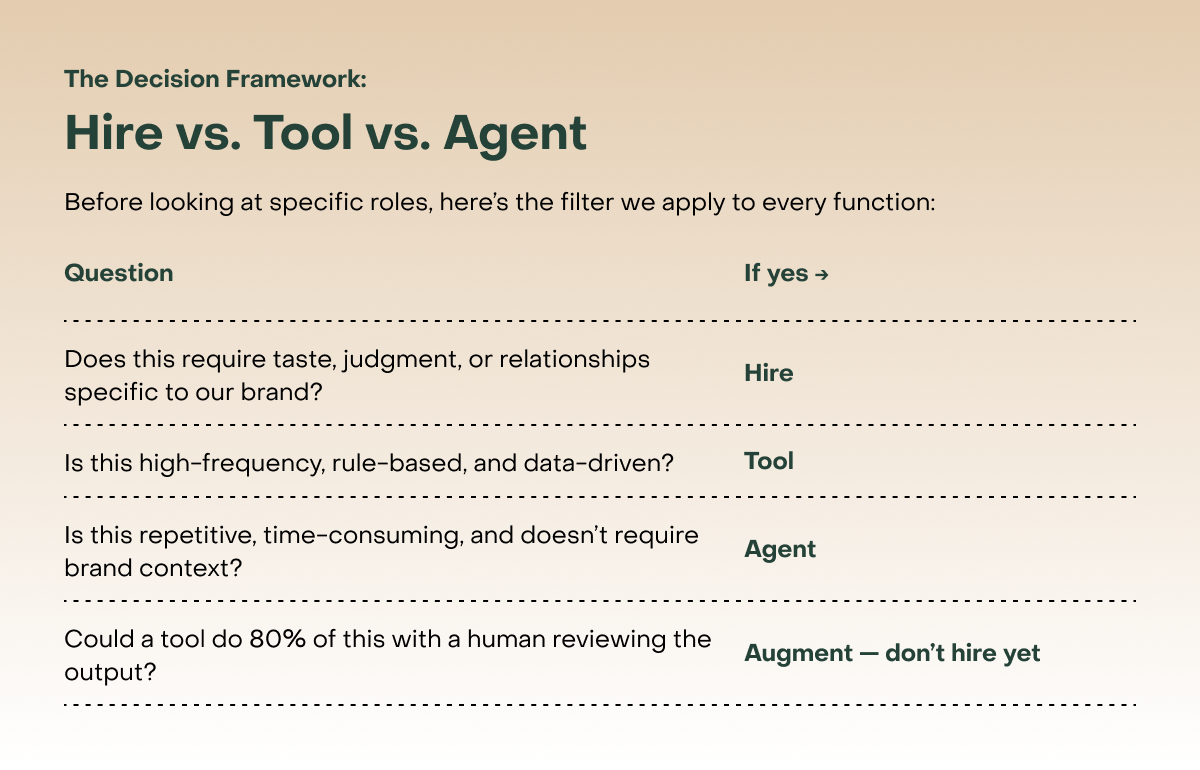
The hardest category is the last one. Most brands hire a full-time person to do a job that a $200/month tool plus 30 minutes of human review could handle just as well. The cost difference over 24 months is staggering, and the opportunity cost of the wrong hire at an early stage is even higher.
A simple rule of thumb: if you can write a detailed SOP for it, you probably don’t need to hire for it yet. SOPs are the prerequisite for automation. If you can document exactly how something should be done, a tool or agent can do it — or at minimum do the first draft that a human refines.
Q2 2026 Update: Claude’s Connectivity Changes the Agent Column
Since we first published this framework, something material has shifted. Claude now connects natively to the platforms consumer brands actually run on including Shopify, Meta, Google Workspace, Slack, Notion, and others. That might sound like a product update, but it’s actually an operating model update.
Here’s what it changes: previously, building an agent loop required a point tool to pull the data, a separate automation layer (Zapier, Make, or custom API work) to route it, and Claude to process and output something useful. This required three steps, three vendors and ongoing maintenance. With native connectivity, steps one and two collapse and Claude becomes both the integration layer and the reasoning layer.
The practical result is that the “Agent” (e.g. Claude or ChatGPT or other) column in every function below is larger than it was when we first wrote the series. Not because the work changed, but because the plumbing required to automate it got dramatically simpler.
One thing that does not change: the Human column. Creative direction, buyer relationships, investor trust, and judgment calls remain stubbornly, correctly human. If anything, native connectivity makes the distinction sharper. The jobs that survive automation are the ones where the output is a relationship or a decision, not a document or a data movement.
The SOP rule still holds, but the bar just dropped. If you can describe a workflow in a prompt, an agent can probably run it now.
The Role-by-Role Breakdown
Here’s how we think about the major functions in a CPG brand — what stays human, what gets augmented, and what gets replaced or automated.
Finance & Reporting
Human: Strategic financial decisions, investor relationships, fundraising narrative, scenario planning
Tool: QuickBooks / NetSuite for accounting, Triple Whale / Crisp for channel reporting, automated WBR scorecard. For brands at $5M–$20M who need faster closes and cleaner reporting without a full system migration, Fincore sits on top of your existing accounting software and compresses financial closes from weeks to a single day — giving you audit-ready analysis in minutes and the financial visibility your investors expect.
Agent: Monthly close checklists, routine variance reporting, invoice processing. With native Shopify and Google Sheets connectivity, Claude can now pull order data, cross-reference ad spend from Meta and Google, and drop a completed WBR scorecard into Slack, with no manual data pulls in between.
Connect Claude to Shopify and Google Sheets. The prompt to set up the loop: "Every Monday, pull last week's Shopify revenue by channel, pull ad spend from Meta and Google Ads, calculate ROAS by channel, and post a summary table to #finance in Slack."
Fincore handles the close; this handles the weekly distribution.
Hiring signal: You need a finance hire (fractional CFO minimum) when you’re approaching a fundraise, entering significant retail distribution, or when financial decisions are being made without a dedicated owner. Not before.
Performance Marketing
Human: Creative strategy, channel mix decisions, agency management, brand positioning
Tool: Triple Whale or Northbeam for attribution, creative testing frameworks, spend dashboards. Once your attribution is clean, Gigit.ai dynamically tailors your landing pages to match the ad each visitor just clicked — no developer work, deploys in under three days. Brands using Gigit see 40–60% conversion uplift, meaning the traffic your ads are already paying for works significantly harder.
Agent: Routine reporting, budget pacing alerts, creative rotation reminders. With native Meta and Google Ads connectivity, Claude can now read performance data directly, flag underperforming creatives, and surface a plain-English briefing to your team in Slack before anyone has logged into a dashboard.
Connect Claude to Meta Ads and Google Ads. Prompt:
“Every morning, check campaign performance against the prior 7-day average. Flag any ad set where CPA is up more than 20% or ROAS is down more than 15%, and post a plain-English summary with the ad set name and recommended action to #growth in Slack.“
Hiring signal: Hire a performance marketing lead when you’re spending more than $150K/month and your agency no longer has the context to make good decisions without daily input from someone who lives inside the brand. Not when you’re at $30K/month and frustrated with ROAS.
The trap: Hiring a performance marketer to fix a creative problem. If your ads aren’t working, the issue is almost never the media buyer, it’s the creative or the offer. No hire fixes that. The right tool (a proper attribution stack) will tell you which one it is.
Content & Community
Human: Brand voice, creative direction, influencer relationships, community response that requires empathy or judgment
Tool: Notion AI / Claude for first drafts, content calendar management, performance analytics.
Nectar Social handles the volume — pulling all social comments, DMs, Reddit and influencer threads, and CX interactions into one place, using AI to respond automatically to routine messages and flagging high-intent conversations for your team. Portland Leather Goods used it to drive $2.7M in revenue from social engagement and cut response time from 6+ hours to under 1 hour. The human job shifts from answering every comment to directing the strategy.
Agent: Publishing and scheduling, UGC collection and tagging, review monitoring. With native Notion and Meta connectivity, Claude can pull from your content calendar, generate captions using live Shopify product data, schedule posts, and monitor comments in a single loop, without a separate scheduling tool.
Connect Claude to Notion and Meta. Prompt:
“Each weekday, check the content calendar in Notion for posts scheduled in the next 48 hours. For any post without a caption, draft one using the brand voice document [link] and the linked Shopify product page. Post the draft to #content in Slack for approval before publishing.”
Hiring signal: Hire a content lead when the bottleneck is the creative direction, not the execution. Until then, Claude plus a clear brand voice document plus Nectar handling the volume is a content and community operation that punches well above its weight.
Retail & Wholesale
Human: Buyer relationships, trade show presence, broker management, pricing and promotional strategy.
Tool: Crisp for sell-through data, Stackline for Amazon intelligence, Swapt for converting anonymous Amazon and TikTok Shop buyers into owned customer relationships, inventory planning software.
Agent: Reorder alerts, sell-through anomaly flags, distributor report aggregation. With native Shopify connectivity, Claude can detect inventory thresholds, draft a purchase order, and send a Slack alert to your ops lead with context attached, closing the loop from signal to action without a human in the middle.
Connect Claude to Shopify. Prompt:
"Check inventory daily. For any SKU below [X units], draft a purchase order using the supplier template in Notion and post it to #ops in Slack with a one-click approve note tagging [name]."
Hiring signal: Hire a VP of Sales when you’re in enough doors that the constraint is relationship management, not data management. A brand in 200 doors doesn’t need a VP of Sales. It needs a broker and a Crisp dashboard.
Operations & Supply Chain
Human: Supplier relationships, quality decisions, production planning that requires judgment
Tool: Inventory management software, demand forecasting tools, QuickBooks for COGS tracking
Agent: Purchase order generation, lead time tracking, out-of-stock alerts
Hiring signal: Hire an ops lead when your supply chain complexity — number of SKUs, co-manufacturers, or markets — exceeds what a founder can manage alongside everything else. This is usually later than founders think.
Executive & Strategic
Human: Vision, culture, investor relations, key hires, strategic partnerships — always
Tool: Notion for strategic planning, Claude for scenario analysis and first-draft thinking
Agent: Calendar management, meeting prep summaries, follow-up drafts. With native Gmail and Google Calendar connectivity, Claude can read your week's context, draft a pre-meeting briefing, and send follow-ups after a call, so the coordination work disappears and the judgment work stays.
Connect Claude to Gmail and Google Calendar. Prompt:
“Each morning, review my calendar for the day and any unread emails from the last 12 hours. Draft a 5-bullet briefing covering: key meetings today, open decisions needed, and anything requiring a reply, and send it to me at 7am.”
Hiring note: The one role that should never be augmented away is the founder’s judgment. AI is a thinking partner, not a decision-maker. The brands that get this wrong are the ones that start optimizing for AI output rather than founder conviction.
What the $100M / 30-Person Brand Actually Looks Like
Here’s the org model we believe the next generation of breakout CPG brands will run on — not as an aspiration, but as a blueprint. Every FTE in this model is a decision-maker, not a coordinator. Coordination is what the tools do. And increasingly, that includes talking to your own store.
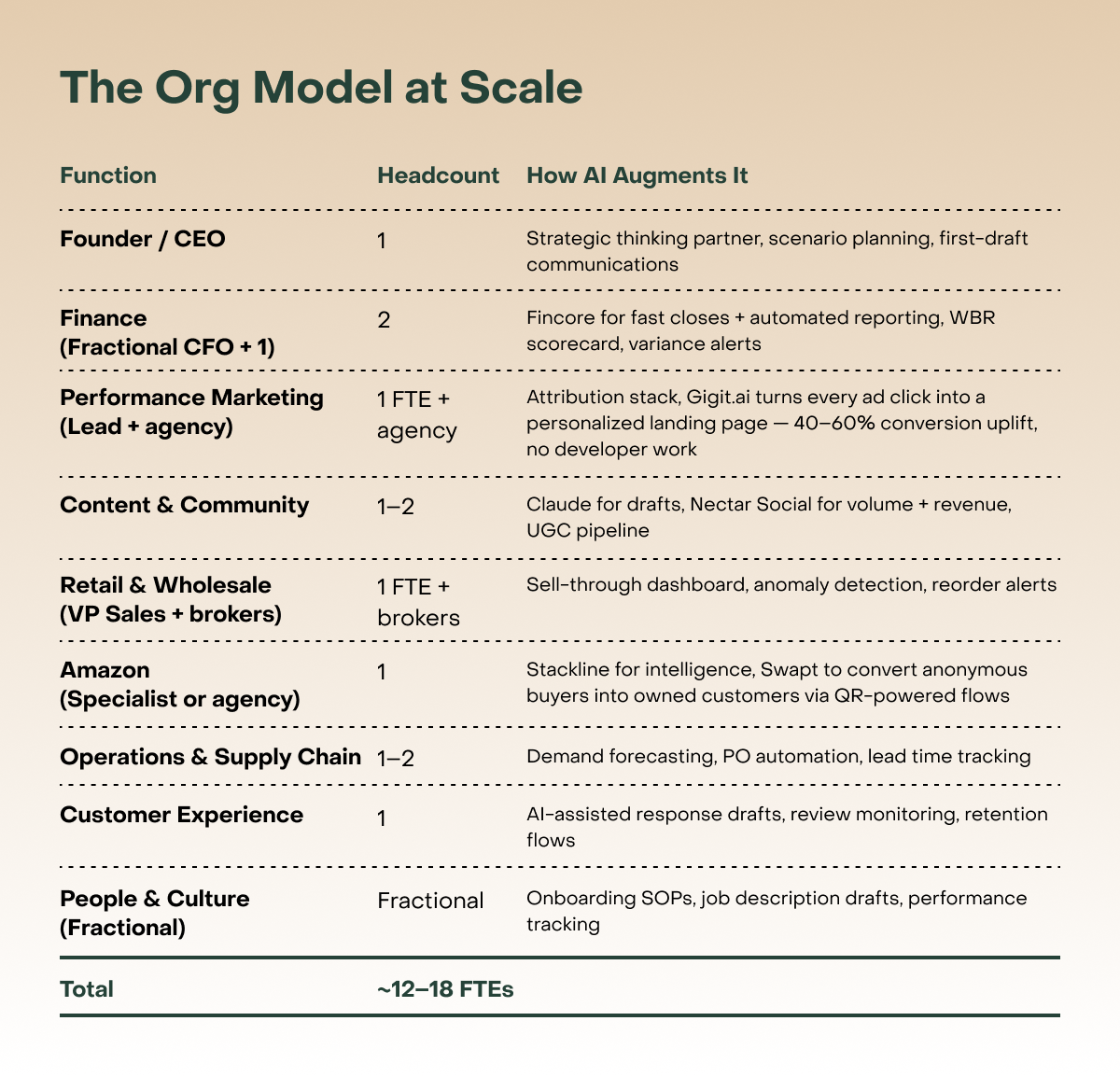
The remaining scale to 30 comes from fractional operators, specialized agencies, and project-based support — not full-time headcount. The key insight: every FTE in this model is a decision-maker, not a coordinator. Coordination is what the tools do.
At $100M in revenue, this team is generating roughly $3M–$5M in revenue per employee. For context:
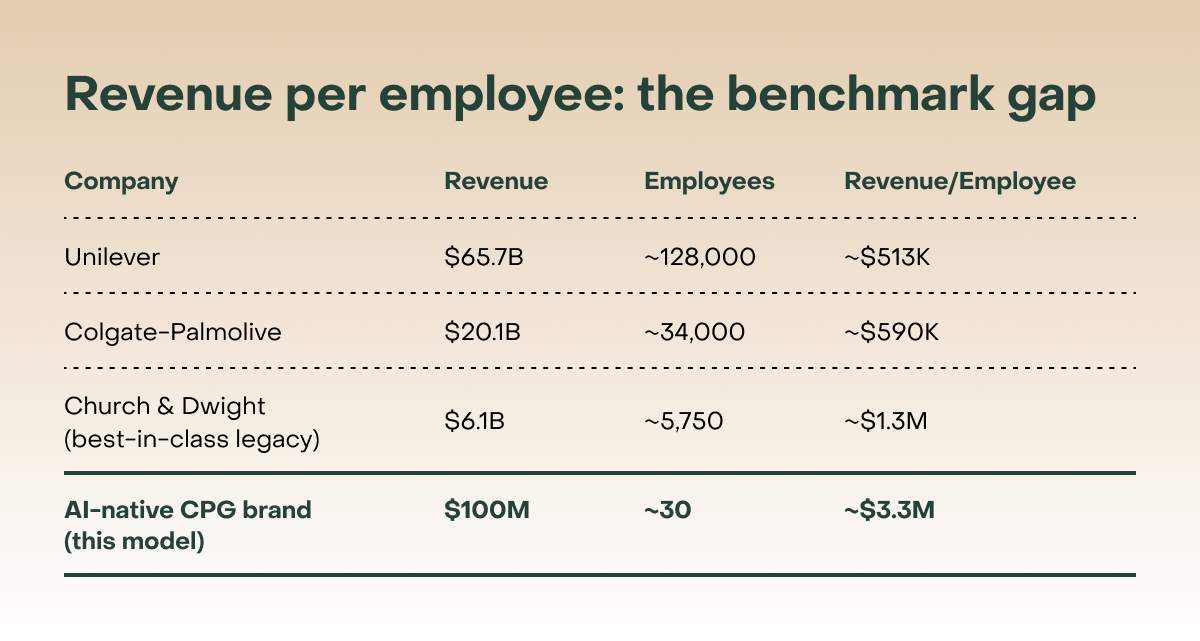
Church & Dwight didn't get to $1.3M/employee by accident — they built a culture and an operating model around lean from day one. The AI-native brand does the same thing, with tools that didn't exist when Church & Dwight was building its playbook. That's not a vanity metric — it's a structural advantage that shows up in margin, in speed, and in the ability to reinvest in growth rather than payroll.
Download the Hire, Tool, or Agent? Decision Framework
The full org chart blueprint — role-by-role breakdown with Human/Tool/Agent split for every function, AI augmentation by function, hiring signals, and the revenue-per-employee benchmark — as a designed one-pager you can print and bring to your next board meeting. Download it here → That’s not a vanity metric — it’s a structural advantage that shows up in margin, in speed, and in the ability to reinvest in growth rather than payroll.
A Note on Implementation
The agent workflows described above are starting points, not finished automations. That distinction matters.
Each one should be run manually a few times before you put it on a schedule. You’re not testing whether Claude can do the task — you’re testing whether your prompt captures all the edge cases your operation actually throws at it. The first run will surface something you didn’t anticipate. That’s the point.
Plan for a two-to-three week review period on any new loop before you stop watching it. The failure mode isn’t that the agent does nothing — it’s that it does something slightly wrong, consistently, and nobody notices until the variance has compounded.
A useful frame: treat every new agent workflow the way you’d treat a new junior hire in their first month. You wouldn’t hand them a task and disappear. You’d check their work, correct the misses, and tighten the brief until the output is reliable. The difference is that with an agent, the “brief” is a prompt you can edit and once it’s right, it stays right.
The brands that get the most out of this aren’t the ones who automate the most. They’re the ones who automate carefully, review honestly, and compound the wins over time.
The Compounding Effect
Here’s the thing about building this way that doesn’t get said enough: it gets easier over time.
Every SOP you write becomes a better AI prompt. Every tool integration you build reduces manual work permanently. Every WBR you run tightens the feedback loop between signal and decision. The institutional knowledge that used to live in people’s heads — and walk out the door when they left — gets captured in systems that compound in value.
There’s a practical version of this that most founders miss: the materials you create for your WBR become the materials for everything else. The strategic topics you pressure-test with your leadership team become your board deck. The scorecard you review every week becomes your investor update. The decision log becomes your operating history. One CEO use to spend weeks working with her CFO, COO and VP of Sales to build a board deck — until she realized they were already building it every week in their WBR. Once the WBR is running well, the data for the board deck is 80% done.
The brands that built this way from the start are more efficient and more resilient.
They don’t have single points of failure. They don’t have six-month knowledge transfer processes when a key person leaves. They don’t have “we need to hire before we can scale” problems because they designed the scaling into the operating model.
This is what we mean when we say the goal isn’t to adopt AI tools. It’s to redesign the operating stack of a consumer brand.
Where to Start on Monday
If you’ve read all four parts and you’re wondering where to actually begin — here’s our answer: it depends on which part made you most uncomfortable.
If Part 1 made you uncomfortable → your foundation isn’t clean. Start with the Day 1 checklist before anything else.
If Part 2 made you uncomfortable → run the audit before your next board meeting. Use the 90-minute working session format.
If Part 3 made you uncomfortable → pick the single highest-friction workflow in your operation and fix that one thing in the next 30 days.
If Part 4 made you uncomfortable → map every function in your business against the hire/tool/agent framework. You’ll find at least two places where you’re paying a human to do something a tool should be doing.
Not sure which part made you most uncomfortable? That’s actually the most common answer — and it’s exactly what we help untangle.
The competitive advantage isn’t in knowing this framework. It’s in actually running it. Same discipline, better tools.
A Final Note from XRC
We built this series because we kept having the same conversation — with founders who were overwhelmed by AI tool choices, with investors who didn’t know how to evaluate operational maturity, and with corporate innovation teams who had the resources but not the roadmap.
Since 2015, XRC has been investing at the intersection of consumer and technology — with 100+ investments across retail tech, CPG, and the tools that power modern brands. We’ve worked alongside the world’s largest retailers, CPG companies, and consultancies, and we’ve seen firsthand what separates the brands that scale efficiently from the ones that grow into complexity they can’t manage.
The brands we’re most excited about aren’t the ones with the most sophisticated AI stack. They’re the ones that understand why each tool is in the stack, who owns each decision, and how fast they can move from signal to action.
That operating discipline is what we bring to every company we work with — as investors, as advisors, and as partners. We’ve run the audit, built the WBR, navigated the hire vs. tool decision, and watched the compounding effect play out in real brands.
If you’re building toward $100M and want a thought partner on how to get there with the right operating model we’d welcome the conversation.
And if you’re an investor, a strategic, or a corporate innovation team that wants to bring this framework to your portfolio or your brands — that’s a conversation we’re actively having with our LPs and partners.
Reach out at dianam@xrcventures.com or find us at xrcventures.com.
Since 2015, XRC Ventures has made 100+ investments at the intersection of consumer and technology, working alongside the world’s largest retailers, CPG companies, and consultancies. This series reflects what we’ve learned building alongside the operators doing it — the hard way, so you don’t have to.